
By Dr. Brown
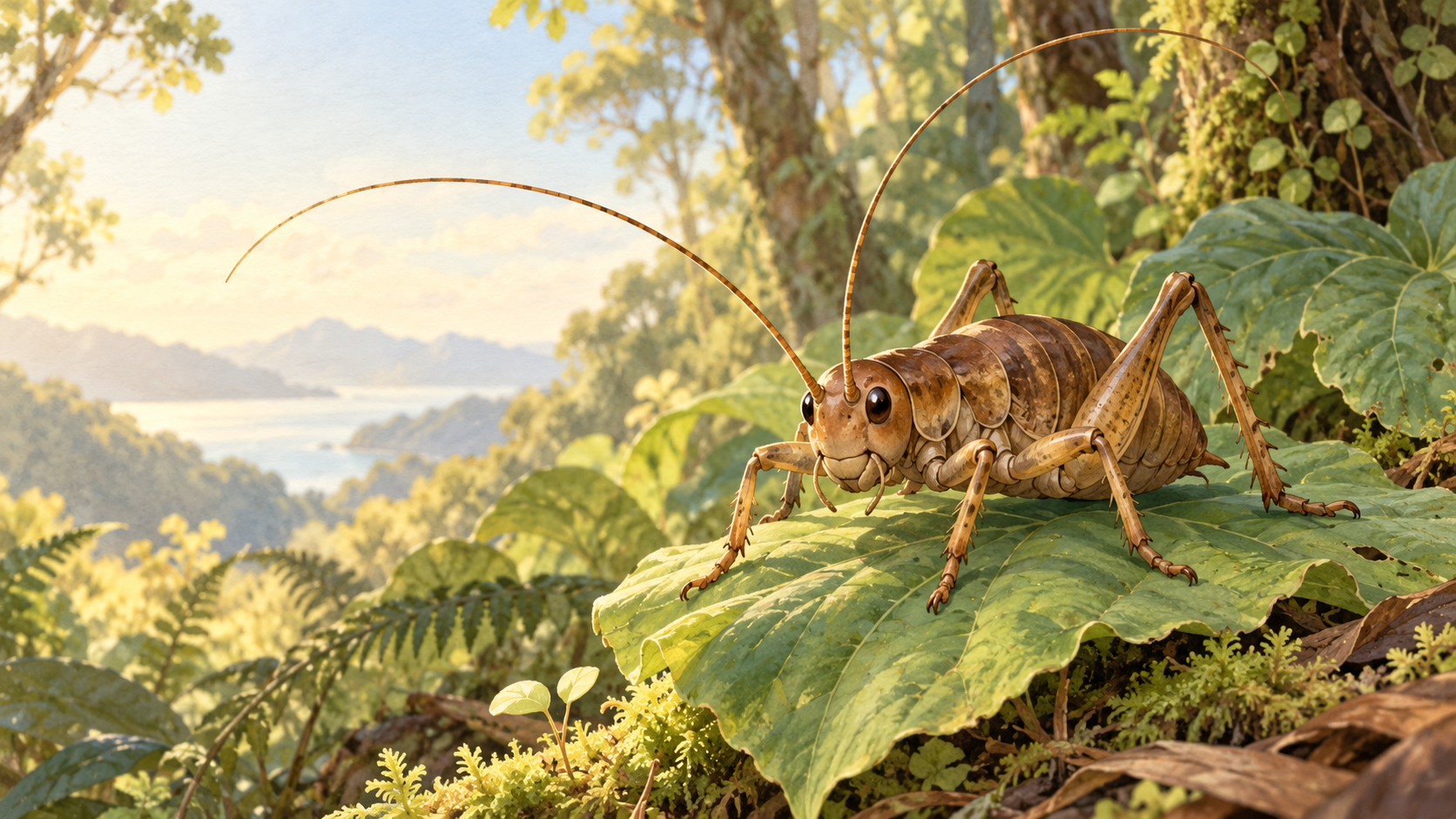
Why the Return of the Wētāpunga Is Bigger News Than It May Seem
Some forms of good news arrive as a dramatic breakthrough. Others take years of patient work before anyone can confidently say: It worked. The recovery of the wētāpunga, New Zealand’s heaviest insect and one of the heaviest insects in the world, belongs to the latter.
Once found across northern New Zealand, the wētāpunga was devastated by habitat destruction and introduced predators such as rats and stoats. Eventually, its only remaining natural population survived on Hauturu-o-Toi, also known as Little Barrier Island. With that population too vulnerable to supply enough insects for direct relocation, conservationists had to develop another approach.
Beginning with small groups of carefully collected wētāpunga, teams at Butterfly Creek and Auckland Zoo learned how to breed them in protected environments. They studied what the insects ate, how they developed, and how to prepare them for release. The work was gradual, specialized, and sometimes uncertain.
Over 15 years, those efforts allowed more than 11,000 wētāpunga to be released at 10 new wild sites. Auckland Zoo alone bred and released 8,874 of the insects between 2014 and 2025.
The most meaningful evidence of success is not simply the number released. Monitoring has identified at least four generations of wētāpunga born in the wild on Motuora and Tiritiri Matangi islands. That means the insects are not merely surviving after relocation- they are reproducing and establishing populations of their own!
Their conservation status has consequently improved from nationally endangered to a nationally increasing or recovering classification.
Why Should We Care About These Insects?
Wētāpunga are part of a lineage that has existed for approximately 190 million years and is found nowhere outside New Zealand. Losing them would mean losing a unique piece of the planet’s evolutionary history.They also perform important work within their forest ecosystems.
Wētāpunga eat native vegetation and help distribute plant seeds as they move through the forest. Their unusually large, nutrient-rich droppings can help seeds germinate while returning nutrients to the soil. In this way, they function as small gardeners: eating, fertilizing, and helping native plants spread. Those plants then provide food and shelter for birds, reptiles, and other insects.
Before introduced land mammals arrived in New Zealand, giant wētā occupied some of the ecological roles filled by small mammals elsewhere. Their disappearance therefore removes a participant from the daily processes that help a forest renew itself.
Protecting wētāpunga also requires controlling introduced predators and preserving native vegetation. Those measures create safer, healthier habitats for many other species. Their recovery is therefore evidence that a wider ecological restoration effort is working (yay!).
Wētāpunga are also considered a taonga, or treasured species, by Ngāti Manuhiri, the mana whenua and kaitiaki of Hauturu-o-Toi. Their recovery reflects not only scientific work but also Indigenous guardianship, community restoration, and cooperation among iwi, zoos, conservation agencies, and local organizations.
Why This Is Such Good News
A species that had been reduced to one vulnerable location now has populations developing at several protected sites. The methods used to breed, release, and monitor the wētāpunga have also been documented so that conservationists can apply what was learned to other threatened invertebrates.
The recovery is not complete. Some newer populations will require years of monitoring before scientists know whether they are fully self-sustaining. Their habitats must also remain protected from the threats that caused the original decline.
Still, the wētāpunga’s progress demonstrates that decline is not always irreversible.
It did not depend on one heroic intervention. It required people to restore the surrounding environment, maintain support over many years, learn from unsuccessful attempts, and give the species enough time to respond.
Resilience is sometimes described as the ability to withstand hardship independently. The wētāpunga tells a more complete story. Recovery can emerge when vulnerability is recognized, support is sustained, and the conditions surrounding a living being become safer.
Sometimes, hope is not a prediction or a feeling. Sometimes, it is what becomes visible after years of people consistently doing the work.
Sources:
Green, C., McFarlane, D., Goodwin, B., Barrett, P., Huang, C.-M., Ayres, J., & Gibson, R. (2026). “Captive Breeding Programme Enables a Successful Wētāpunga Recovery Programme.” New Zealand Journal of Zoology, 53(3), e70061.
New Zealand Department of Conservation. (October 2, 2026). “Science Paper Outlines Blueprint for Successful Giant Wētā Recovery.”
Auckland Zoo. “Auckland Zoo and Motuihe Trust Team Up to Help Rare Forest Giant.”
Auckland Zoo. “Returning Wētāpunga to the Bay of Islands After a 180-Year Absence.”